This is a staging instance and does not serve clients. For day-to-day operations, head over to production. If you want access to our private preview features, contact us at [email protected].

Strategic case study — proposed application, not a claim of an existing Bundeswehr deployment. This analysis combines public Bundeswehr and German parliamentary evidence with Facthory's platform capabilities to assess where operational knowledge could become a readiness multiplier.
Germany is committing unprecedented capital to defence. The harder question is whether the Bundeswehr can convert that capital into usable combat capability at the same speed.
The evidence points to a structural bottleneck. Equipment procurement is accelerating sharply. Personnel growth is not. Training remains distributed across roughly 130 institutions. Operational readiness remains constrained. Expertise is concentrated in experienced personnel who cannot be replicated on procurement timelines.
The result is an absorption-capacity gap: Germany can buy modern platforms faster than it can scale the human knowledge required to operate, maintain, troubleshoot and adapt them.
That gap is where Facthory fits.
Capital is scaling faster than operational capacity. German military procurement is planned to rise from €32.3 billion in 2025 to roughly €45 billion in 2026 and more than €60 billion in the 2027 budget proposal. That is an extraordinary increase in systems entering the force, while active military personnel reached 184,194 at the end of 2025 — still 18,806 below the long-standing 203,000 target. German Bundestag — defence budget German Bundestag — personnel
Readiness cannot be solved by procurement alone. In February 2025, the head of the German Armed Forces Association estimated German land-force readiness at around 50%, down from about 65% across eight brigades before Russia's full-scale invasion of Ukraine. The Ministry of Defence did not publish an overall readiness rate because detailed readiness information is classified, but acknowledged that Germany continues to face major capability requirements. Reuters, 13 February 2025
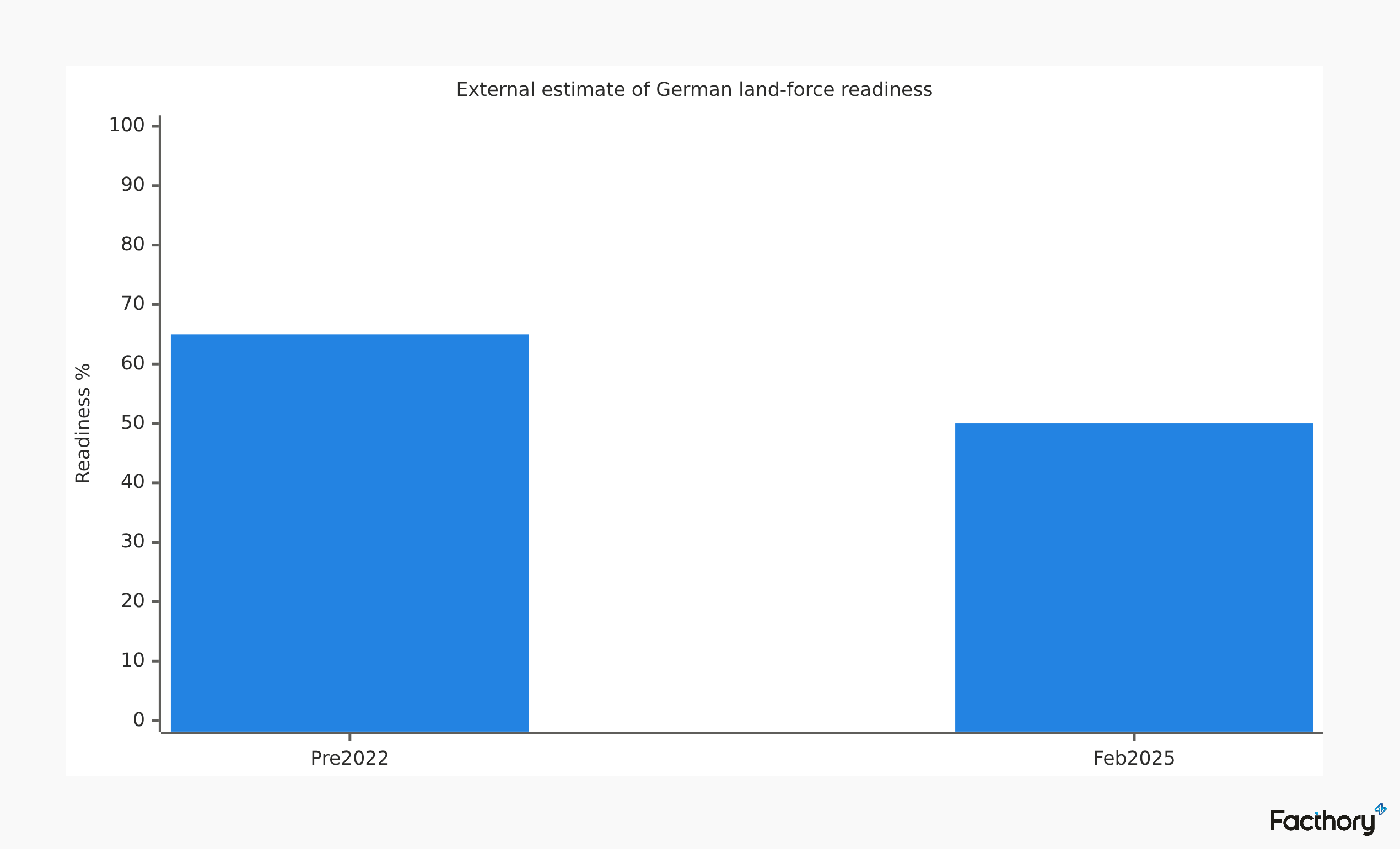
This is an external estimate attributed by Reuters to Col. André Wüstner, not an official Bundeswehr-wide readiness disclosure.
Training scale is itself an infrastructure constraint. Fraunhofer FOKUS states that the Bundeswehr operates around 130 training institutions and is consolidating fragmented digital learning activities through the Virtuelle Lernumgebung der Bundeswehr. This is important digital infrastructure, but a learning platform does not by itself capture the tacit diagnostic knowledge of a senior technician at the point of work. Fraunhofer FOKUS
The scarce resource is experienced judgment. New equipment increases the number of procedures, failure modes, software states, maintenance exceptions and cross-platform dependencies personnel must master. Unlike hardware, experienced technicians and instructors cannot be ordered with a delivery date.
The operational opportunity is not another chatbot. The opportunity is to turn distributed expertise, manuals, maintenance history, video demonstrations, incident evidence and validated procedures into a governed operational memory that can be reused at the point of need.
If defence procurement continues to grow by tens of billions of euros while experienced personnel and training capacity grow slowly, readiness will increasingly be constrained by the force's ability to absorb, transfer and reuse operational knowledge — not simply by the availability of equipment.
That changes the technology question.
The relevant question is no longer: Can the Bundeswehr digitize more manuals?
It is: How quickly can one expert's validated knowledge become usable capability for every authorized soldier who needs it?
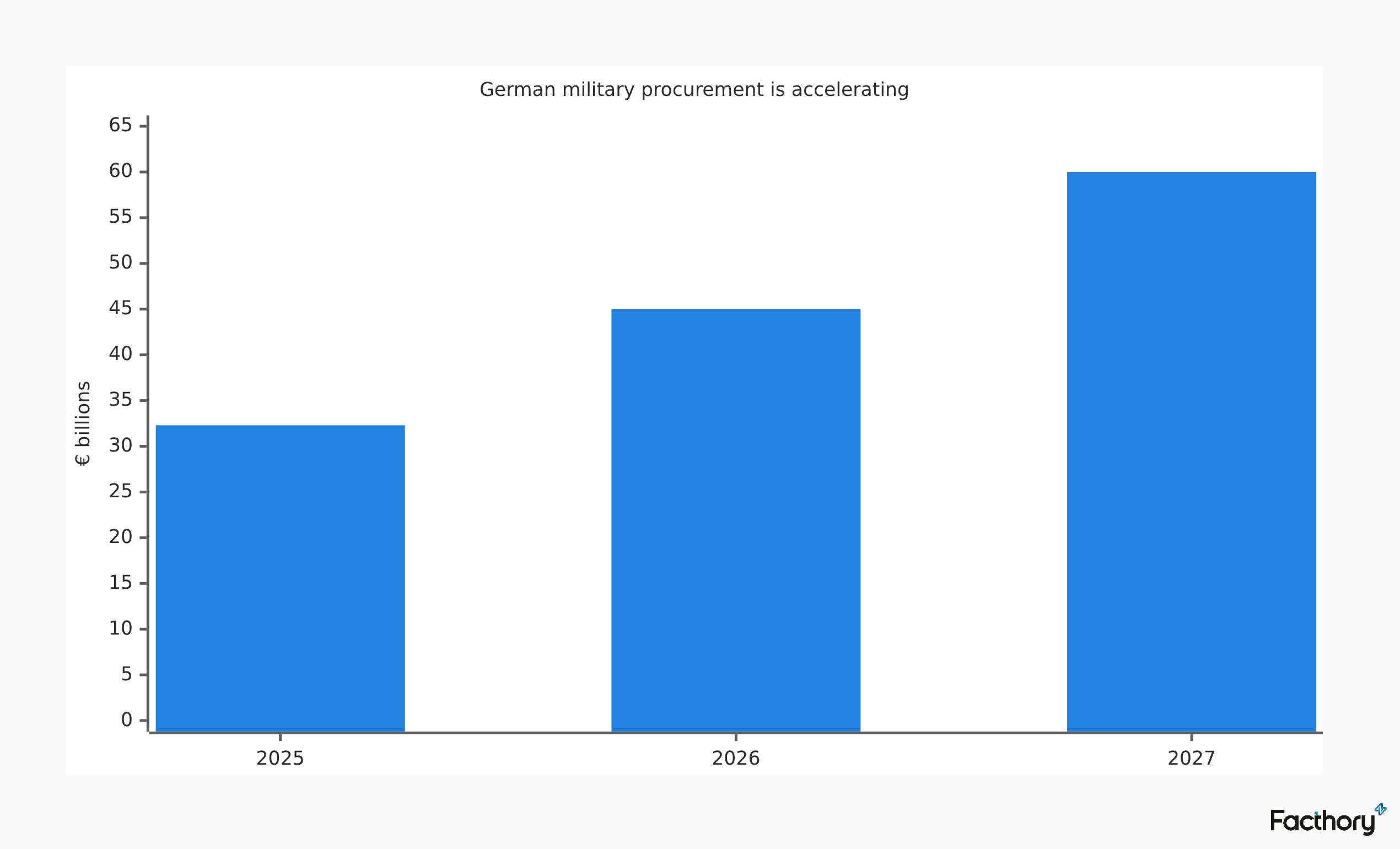
_2027 is shown at €60 billion as a conservative floor; the current federal budget proposal states military procurement of more than €60 billion. Source: German Bundestag._ The capital curve is steep because Germany must replenish stocks, modernize systems and meet larger NATO commitments. But procurement creates a second-order requirement: each additional platform must be introduced, learned, maintained, diagnosed, updated and supported. Personnel does not scale on the same curve.
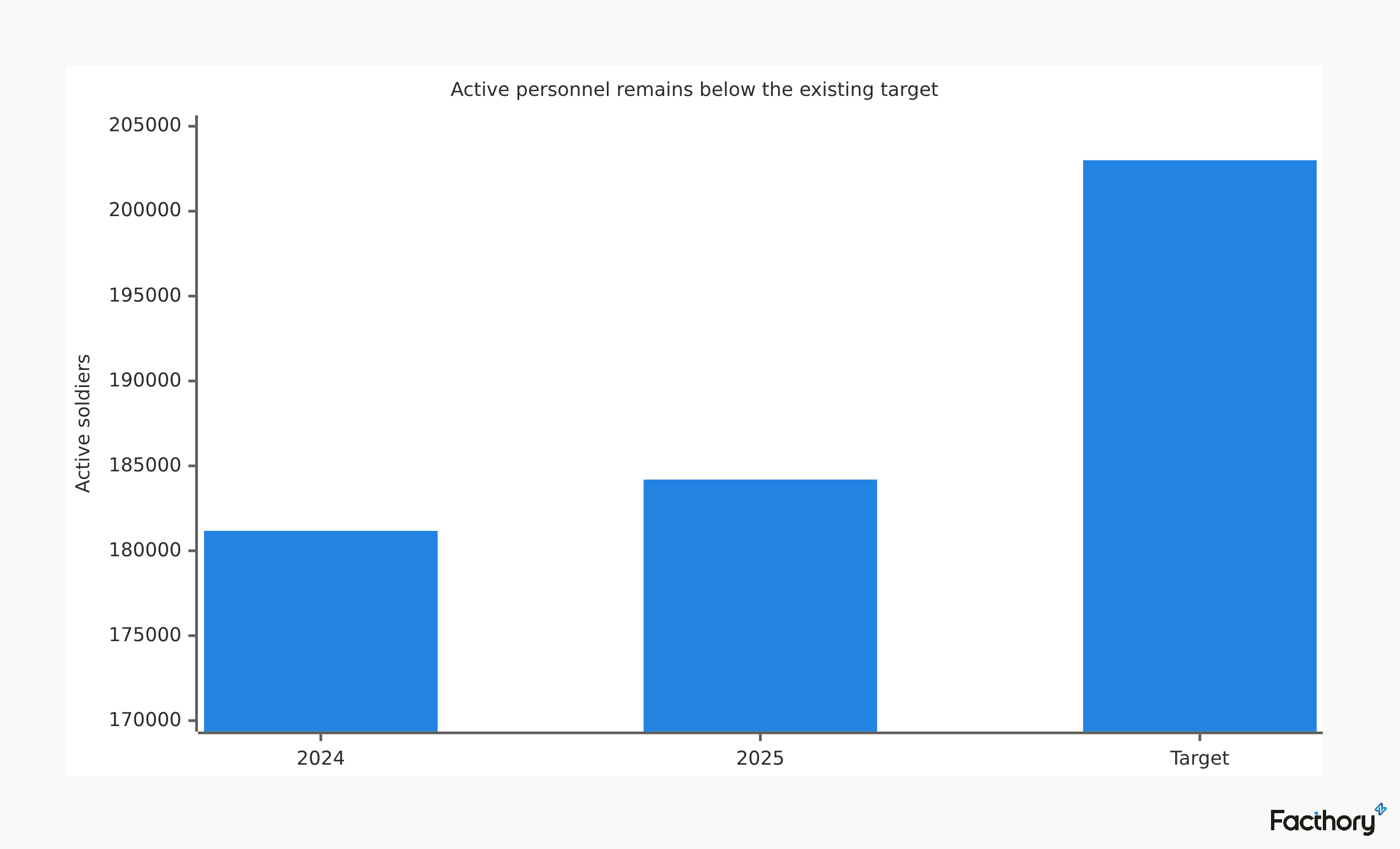
End-2024 and end-2025 active military personnel compared with the existing 203,000 target. Source: Parliamentary Commissioner for the Armed Forces / German Bundestag.
At the end of 2025, the Bundeswehr remained 18,806 active soldiers below the 203,000 target, despite 2025 being described as the strongest recruiting year since conscription was suspended. The previous Parliamentary Commissioner also warned that the force lacked sufficient instructors, equipment and accommodation to scale recruitment rapidly. German Bundestag
This is the central asymmetry: equipment can be procured with money; expertise must be accumulated, transferred and retained.
Military readiness is usually discussed in terms of personnel, ammunition, spare parts and platform availability. Those are indispensable. But each of them has an information layer.
A spare part only restores readiness when the fault is diagnosed correctly. A new platform only adds capability when crews can operate it. A maintenance manual only helps when the correct procedure can be found, understood and applied under the actual conditions of the failure. A lesson from an exercise only creates institutional value when another unit can retrieve and reuse it later.
This becomes more important as platforms become software-defined, sensor-heavy and electronically integrated.
The 2022 Puma incident is an extreme illustration. Eighteen deployed Puma infantry fighting vehicles became unavailable during a preparation exercise, triggering intense scrutiny of reliability, maintenance and support. The specific technical causes were subsequently assessed and remediated, but the larger lesson remains relevant: on modern platforms, readiness can disappear through combinations of electronics, software, components, operating conditions and maintenance knowledge rather than one obvious mechanical fault.
A force cannot solve that class of problem with static documentation alone.
| Constraint | Operational consequence | What must change |
|---|---|---|
| Expert concentration | High-value diagnostic knowledge remains dependent on a small number of experienced NCOs, technicians and instructors. | Capture expertise while it is being demonstrated and make validated knowledge reusable. |
| Fragmented evidence | Manuals, maintenance records, video, lessons learned and technical data remain separated by system and format. | Connect evidence around the actual asset, procedure, failure and outcome. |
| Training latency | New lessons take time to move from expert experience into formal courseware and across institutions. | Shorten the path from validated field learning to controlled reuse. |
| Point-of-need access | Personnel often need guidance when equipment is already unavailable, not weeks later in a classroom. | Deliver authorized, evidence-linked guidance inside the operational workflow. |
The Bundeswehr's Virtuelle Lernumgebung is strategically important. Fraunhofer describes a future learning ecosystem that integrates approximately 130 training institutions, reduces isolated systems, supports role and rights management, and strengthens digital sovereignty.
That addresses the distribution layer of training.
The remaining opportunity is the operational knowledge layer: capturing what experienced personnel know that is not yet adequately represented in courseware, manuals or structured systems, connecting it to technical evidence, validating it, and delivering it when the work occurs.
The distinction matters.
A learning management system answers: Which course should this soldier complete?
An operational knowledge system must answer: This platform is showing this fault, under these conditions, after these previous interventions. What validated evidence and procedure are relevant now — and who has authority to approve the next action?
Facthory would not replace Bundeswehr training systems, command systems, maintenance systems or authoritative technical documentation. It would sit across them as a governed operational-context layer.
The proposed model has four jobs:
Senior technicians and instructors demonstrate difficult procedures, diagnostics and exceptions using video, voice, images and existing documents. Facthory converts those sources into structured, searchable knowledge while preserving source evidence and timestamps.
A 20-minute expert demonstration should not remain a 20-minute video somebody has to rewatch. It should become a reusable operational asset: procedure steps, visible states, tools, warnings, prerequisites, related platform, failure signatures and the exact video evidence behind each answer.
A maintenance database may contain the fault code. A manual contains the approved limit. A training video shows the physical sequence. A senior technician explains the workaround. An incident report records what happened last time.
Traditional repositories store five separate records.
Facthory's role is to connect them around the same operational problem so authorized users and agents can reason from the full evidence set rather than one document at a time.
The target experience is not generic question answering. It is evidence-linked operational assistance.
A technician should be able to ask a bounded question such as:
Show the approved diagnostic sequence for this subsystem fault, the required tools, the relevant warning, and the exact source evidence.
The response should be grounded in the authorized knowledge set, point back to the source material and respect role, unit, system and classification boundaries.
For multinational operations, the same validated procedure can be rendered in German and English without creating two diverging bodies of procedural knowledge.
Military AI cannot make authority ambiguous.
Facthory is designed so model output does not become authorization. Routine retrieval and analysis can be automated, while consequential actions can require expert review, named decision rights, separation of duties or multi-person approval. Evidence, recommendation, approval and outcome remain traceable.
This is particularly important in maintenance, safety, logistics and mission-support environments where a plausible answer is not the same thing as an authorized action.
The economic case is not primarily software cost savings.
The relevant asset base is the tens of billions of euros Germany is putting into military equipment, sustainment and modernization. The commercial argument for Facthory is that a small improvement in the force's ability to absorb and reuse expertise protects the value of a vastly larger capital program.
For an armed force, the highest-value outcomes are operational:
faster time to competence on new and upgraded systems
lower mean time to diagnose and repair known failure classes
higher first-time-fix rate
fewer repeated expert interruptions for recurring problems
faster propagation of validated lessons across units
lower dependency on individual experts for routine troubleshooting
stronger consistency between training, field practice and authoritative procedure
auditable provenance for AI-assisted guidance
multilingual reuse without duplicating the underlying knowledge base
preservation of scarce expertise before reassignment or retirement
The business case should therefore be measured against readiness hours recovered, expert hours multiplied, training latency reduced and avoidable equipment downtime prevented — not against the number of chatbot conversations.
A credible programme should start narrow enough to measure and consequential enough to matter.
Recommended scope: one platform or technical domain, one training centre, one operational maintenance unit, 10–20 senior subject-matter experts, and 50–100 high-value diagnostic or procedural knowledge assets.
The pilot should establish a baseline before deployment and measure the same work after deployment.
| Measure | Baseline question | Target signal |
|---|---|---|
| Mean time to trusted answer | How long does a technician need to locate usable guidance today? | Material reduction |
| Mean time to diagnose | How long until the probable fault and next approved diagnostic step are identified? | Material reduction |
| First-time fix | How often is the issue resolved without repeated escalation? | Increase |
| Expert interruption load | How often are senior experts pulled into recurring questions? | Reduction |
| Knowledge reuse | How often is one validated lesson reused across personnel or units? | Increase |
| Evidence compliance | Can every AI-assisted recommendation be traced to authorized source material? | Near-complete traceability |
| Training latency | How long from validated lesson to controlled availability for others? | Material reduction |
No production-scale claim should be made until these measures are demonstrated. That is precisely why the first deployment should be designed as an operational experiment rather than a broad AI rollout.
Facthory's differentiation is not a larger language model. Foundation models will continue to commoditize.
The defensible layer is the operational system around them:
Multimodal capture across documents, video, voice, images, structured systems and technical evidence
Persistent operational context that connects assets, procedures, incidents, people, evidence and outcomes
Evidence-linked answers rather than ungrounded conversational output
Durable human-agent workflows for investigations and long-running technical work
Human authority controls for review, approval, escalation and multi-person decision gates
Sovereign deployment through managed, customer-owned cloud, private-cloud and on-premises deployment models
Enterprise identity and access controls so existing authority remains authoritative
Model flexibility so deployment is not permanently tied to one external model provider
For defence environments, the final point is fundamental. The knowledge layer cannot require unrestricted export of operational context to a public SaaS boundary. Facthory is designed to operate inside the deployment and sovereignty envelope the customer requires.
Germany's defence transformation is entering a different phase.
The early debate focused on whether sufficient money would be allocated. The next constraint is whether the Bundeswehr can absorb the resulting equipment, personnel and mission complexity quickly enough to produce readiness.
That is an organizational learning problem as much as a procurement problem.
The Bundeswehr already has experts. It already has manuals. It already has training institutions. It already has maintenance systems and growing digital infrastructure.
The problem is that the knowledge required to turn those assets into readiness is distributed across people, systems, media and organizational boundaries — and it moves more slowly than the capital programme around it.
Facthory's proposition is straightforward: capture that knowledge once, govern it, connect it to operational evidence, and make it available to every authorized person who needs it.
Not another assistant.
A readiness multiplier for the expertise Germany already has.
German Bundestag — 2027 defence budget proposal and procurement growth
German Bundestag — 2025 report of the Parliamentary Commissioner for the Armed Forces
German Bundestag — personnel and training-capacity discussion
Fraunhofer FOKUS — Virtual Learning Environment of the German Armed Forces
Reuters — German land-force readiness assessment, 13 February 2025
