This is a staging instance and does not serve clients. For day-to-day operations, head over to production. If you want access to our private preview features, contact us at [email protected].
Manufacturers are investing heavily in automation, AI, predictive maintenance, and smart factories. But many still depend on something far less visible: a small number of experienced people who know how the operation actually works.
Which vibration is normal. Which supplier deviation matters. Which alarm can wait. Which sequence avoids a recurring defect. Which machine needs a different setup after a tooling change. Which workaround is safe, and which one only looks safe.
That knowledge rarely exists in one document. Much of it is tacit, contextual, and accumulated over years.
And it is becoming a measurable business risk.
The knowledge problem is not that manufacturers have too few documents. It is that they often cannot see which critical work depends on knowledge that lives in too few people.
APQC's 2025 research on the "Great Retirement" surveyed 1,000 professionals and found that only 8% of organizations consistently capture knowledge from departing retirees. Another 16% do not attempt to capture it at all. APQC also reports that 85% of C-suite leaders are concerned about the loss of critical knowledge. Source: APQC
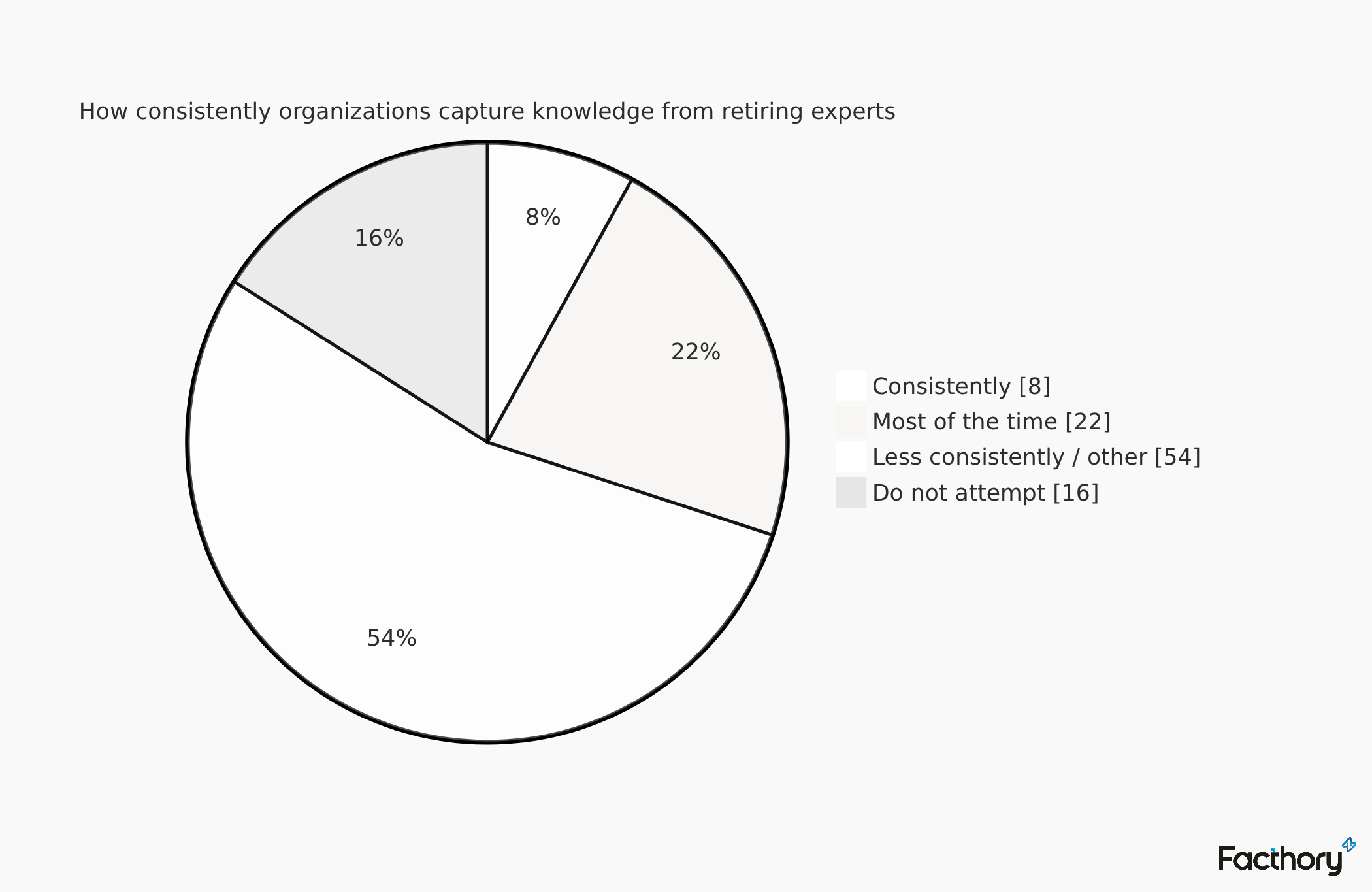
Chart note: APQC reports 8% capture retiring-expert knowledge consistently, 22% most of the time, and 16% do not attempt capture. The remaining 54% represents other lower-consistency responses in the survey.
The usual response is to start a knowledge-transfer exercise when someone announces retirement.
That is late.
By then, the organization is trying to reconstruct decades of operational judgment under a deadline. The expert has to remember what is important, explain it out of context, and somehow convert thousands of exceptions and decisions into documents that another person can use later.
A better approach starts much earlier: identify where knowledge is concentrated before the organization loses access to it.
The talent pipeline makes the issue harder.
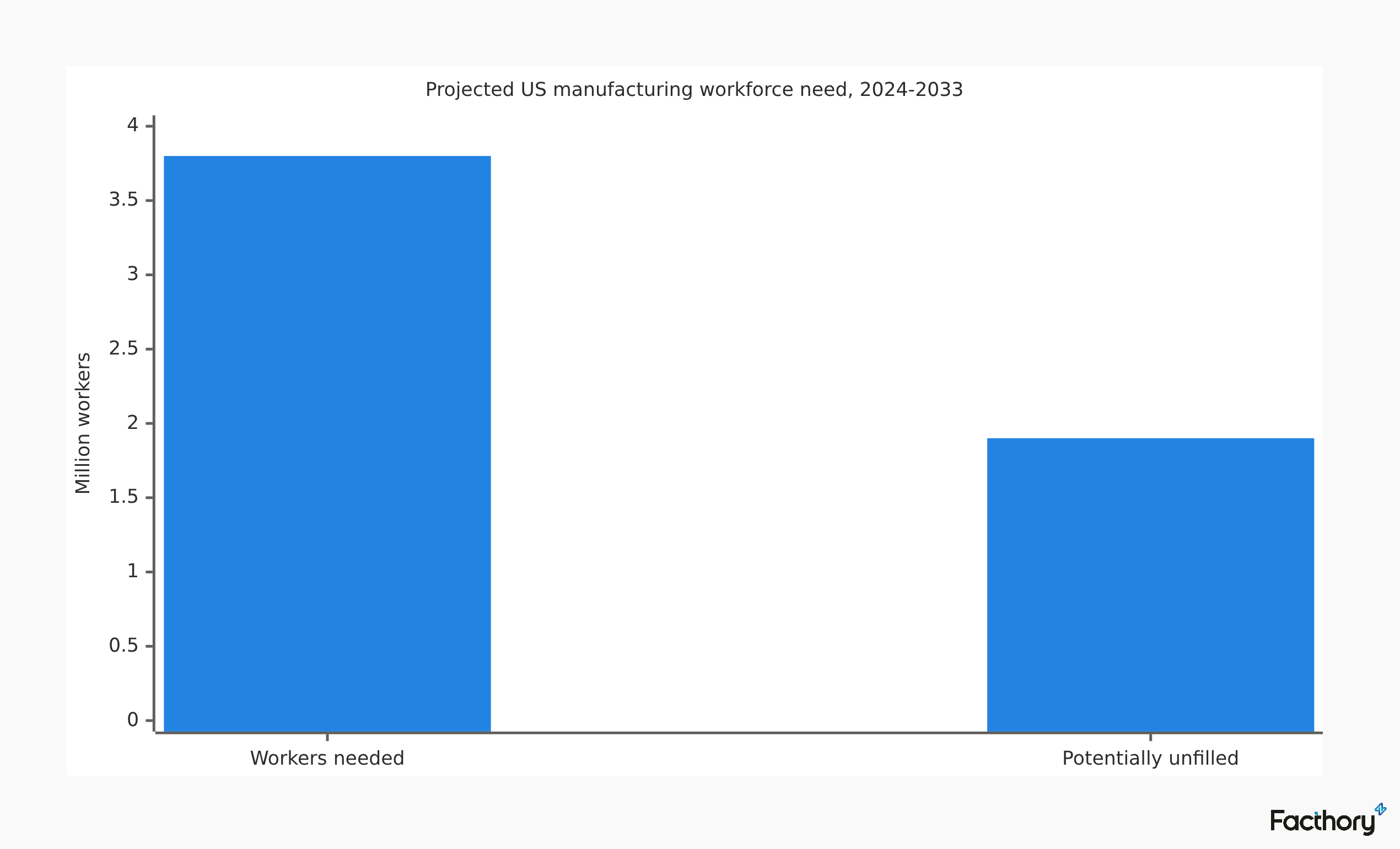
Deloitte and The Manufacturing Institute estimate that US manufacturing may need about 3.8 million new workers between 2024 and 2033, with roughly 1.9 million roles potentially going unfilled if current talent challenges persist. Source: Deloitte and The Manufacturing Institute
At the same time, the knowledge required to do the work is changing. The World Economic Forum's Future of Jobs Report 2025 says 63% of employers identify skills gaps as a major barrier to business transformation, while 39% of workers' existing skill sets are expected to change or become outdated by 2030. Source: World Economic Forum
This creates a double exposure for manufacturers:
experienced people are leaving
replacement talent is difficult to find
existing roles are changing
new workers need to become productive faster
The question is no longer simply, "How do we document what our experts know?"
It is, "Where is our operational knowledge fragile, and what do we do about it before it becomes a production problem?"
A plant may have thousands of SOPs and still carry enormous knowledge risk.
Imagine a critical packaging line. The approved procedure exists. Maintenance history exists. Training material exists. Yet only two technicians know that a specific combination of humidity, film supplier, and machine temperature creates a failure that looks like a mechanical alignment problem.
On paper, the process is documented.
Operationally, the knowledge is concentrated in two people.
That distinction is what a knowledge-risk assessment needs to expose.
Facthory evaluates knowledge in the context of the work that depends on it. The relevant questions are not only whether a document exists, but whether critical knowledge is:
concentrated in one person, team, shift, or site
undocumented or only partially captured
current and validated against actual practice
accessible to the people who need it
transferable to successors
sufficient for people and AI agents to perform dependable work
The result is a living view of knowledge risk rather than a document inventory.
Traditional knowledge management is usually single-player.
One expert writes a document. One employee searches for it. One user asks an assistant a question.
Real knowledge transfer does not work that way.
An experienced technician may demonstrate a procedure while an engineer explains the underlying constraint. A quality lead may challenge part of the explanation because a similar failure had a different root cause. A maintenance specialist may add machine history. A new operator may ask the question that reveals the instruction is ambiguous.
That is why Facthory's approach is multiplayer.
People and specialist agents can work inside the same persistent context. An agent can identify a process with high expertise concentration. Another can assemble the relevant procedures, incidents, videos, maintenance history, and prior decisions. The expert can explain what is missing using voice, video, images, or conversation. Other specialists can validate the result. A learning workflow can then turn the validated knowledge into role-specific guidance.
The knowledge-transfer process becomes collaborative work, not a one-time interview.
| Traditional knowledge capture | Facthory multiplayer workflow | |
|---|---|---|
| Trigger | Retirement or resignation | Continuous knowledge-risk detection |
| Capture | Documents and interviews | Documents, work evidence, video, voice, images, conversations |
| Validation | Usually one author or reviewer | Experts, operators and specialist agents in shared context |
| Risk view | Document completeness | Business criticality, concentration, trust and availability |
| Outcome | Stored knowledge | Reusable operational memory |
The most valuable manufacturing knowledge is often not a standard procedure.
It is the exception.
"If the pressure drops after this alarm, check the upstream valve before replacing the sensor."
"This defect looks cosmetic, but when it appears after the third tool change it usually means the fixture is beginning to drift."
"The machine can run at that setting, but only with material from supplier A."
These are small pieces of information with disproportionate operational value. They are also difficult to capture through a conventional document migration or enterprise search project because nobody has explicitly written them down.
Facthory is designed to capture knowledge where it appears: in documents, videos, conversations, incidents, investigations, procedures, maintenance activity, and collaborative problem solving. Validated decisions and outcomes become part of a Living Operational Model that future people and agents can reuse.
That changes the economics of knowledge transfer. Instead of paying repeatedly to rediscover the same operational judgment, the organization accumulates it.
There is another reason to measure knowledge risk now.
Enterprises are beginning to give AI agents more responsibility. But an agent trained or connected to incomplete, outdated, or contradictory organizational knowledge simply automates the gap.
A company that cannot answer "Which source is authoritative?", "Who still knows this process?", or "Is this procedure current?" has an AI-readiness problem as much as a knowledge-management problem.
This is why Facthory treats agent readiness as part of knowledge risk. Before an agent can perform consequential work, the organization needs sufficient validated context, evidence, permissions, and ownership around that work.
The goal is not to replace expertise with AI.
The goal is to make expertise durable enough that people and agents can build on it.
Manufacturers already monitor machine health, supplier risk, quality deviations, cybersecurity exposure, and financial concentration.
Critical knowledge deserves the same treatment.
If a production process depends on one machine, leaders call that a single point of failure. If it depends on one supplier, procurement tracks the concentration risk.
If it depends on one 61-year-old technician who has never written down the real troubleshooting sequence, the risk is no less real simply because it is harder to see.
Facthory's objective is to make that dependency visible early enough to act on it: capture the expertise, validate it with the people who use it, transfer it into the workforce, and preserve it as shared operational memory.
The organizations that do this well will not merely retain more knowledge.
They will recover faster, onboard faster, make AI more dependable, and become less dependent on who happens to be on shift when something goes wrong.
